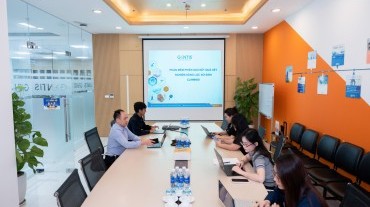

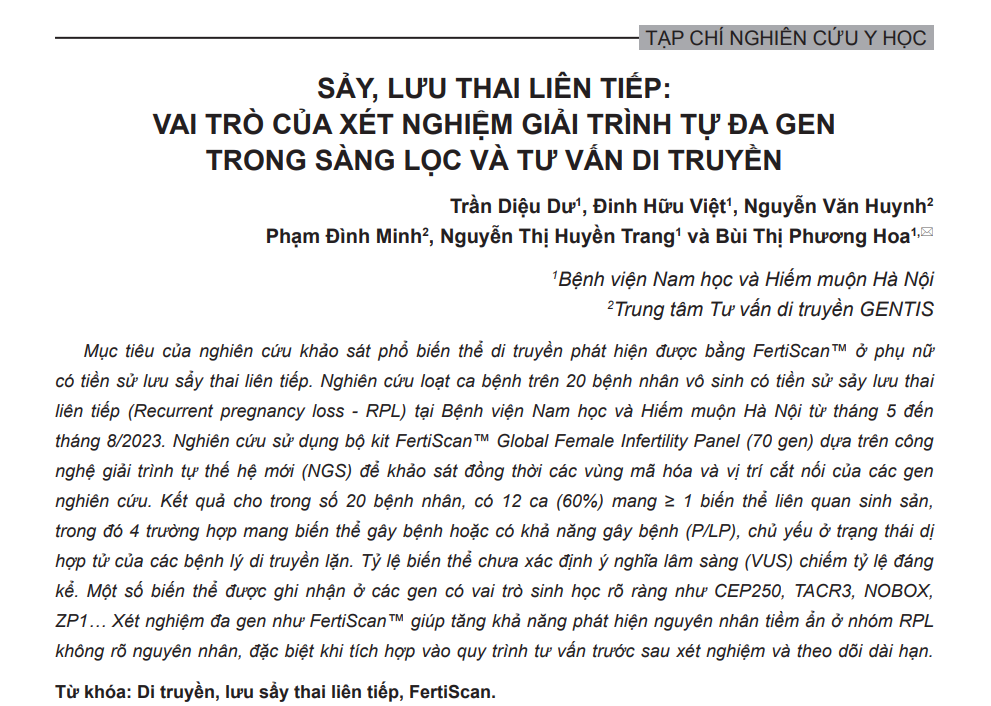
The research findings were presented in the scientific article entitled: “Recurrent Pregnancy Loss: The Role of Multigene Sequencing in Genetic Screening and Counseling,” which was published in Journal of Medical Research, Issue No. 197, December 2025 — a prestigious journal featuring original research and review articles in basic medicine, clinical medicine, preventive medicine, public health, and medical sociology, aimed at advancing medical knowledge and practice.

The study was conducted on 20 infertile patients with a history of recurrent pregnancy loss at the Hanoi Hospital of Andrology and Infertility between May and August 2023. According to experts, recurrent miscarriage and fetal loss represent a major challenge in assisted reproduction, affecting approximately 1–5% of women of reproductive age.
In recent years, next-generation sequencing (NGS) panels have enabled simultaneous analysis of multiple genes related to female reproduction, significantly expanding the ability to identify genetic etiologies in patients with recurrent miscarriage and fetal loss.
Among these tools, the FertiScan™ Global Female Infertility Panel is particularly comprehensive, covering more than 70 genes involved in key pathogenic mechanisms, including: Premature ovarian failure and ovarian dysfunction. Ovarian dysgenesis. Oocyte maturation defects. Abnormal oocyte–zona pellucida–fertilization interactions. Genes affecting implantation and endometrial signaling. DNA repair genes associated with early embryonic lethality
In this study, researchers used the FertiScan™ Global Female Infertility Panel (70 genes) based on NGS technology to simultaneously examine coding regions and splice sites of the target genes.
Among the 20 patients, 12 cases (60%) carried ≥ 1 reproduction-related genetic variant, including: 4 patients harboring pathogenic or likely pathogenic variants (P/LP). Predominantly in the heterozygous state of autosomal recessive disorders.
A substantial proportion of detected variants were classified as variants of uncertain significance (VUS). Notably, variants were identified in genes with well-established biological roles, such as CEP250, TACR3, NOBOX, ZP1, and others.
The FertiScan™ test which identifies genetic causes of infertility and rare hereditary abnormalities associated with female infertility and recurrent miscarriage, as well as evaluates male reproductive health — significantly enhances the detection of monogenic causes in patients with RPL, particularly in cases without chromosomal abnormalities detected by karyotyping or microarray analysis.
The test also supports personalized genetic counseling, including: Partner testing in autosomal recessive conditions. Indications for PGT-M (preimplantation genetic testing for monogenic diseases). PGT-SR (preimplantation genetic testing for structural chromosomal rearrangements). Development of tailored prenatal and preconception screening strategies
Beyond its clinical value, FertiScan™ demonstrates strong potential in genetic epidemiology research in Vietnam, contributing to the establishment of population-specific variant databases and thereby improving variant interpretation, diagnostic accuracy, counseling, and future clinical interventions.
Researchers concluded that multigene testing such as FertiScan™ significantly improves the detection of underlying causes in unexplained RPL cases, particularly when integrated into comprehensive pre- and post-test counseling and long-term follow-up.
Sharing insights on the study, Dr. Pham Dinh Minh, R&D Director of Eurofins GENTIS and co-author of the publication, stated:“Publishing in the Journal of Medical Research is a long journey — from idea generation, study implementation, data analysis, manuscript preparation, submission, to rigorous peer review. Beyond scientific merit, the research must demonstrate strict methodological rigor and data integrity. We spent more than three months collecting data and over two years completing the project. The publication of this work is a source of pride for our team and opens new avenues for research in infertile women with recurrent pregnancy loss, helping realize the dream of parenthood for many couples and highlighting the immense potential of genetic applications in reproductive medicine in Vietnam.”
Through systematically conducted research and publication in prestigious scientific journals, Eurofins GENTIS and the Hanoi Hospital of Andrology and Infertility continue to reaffirm their joint commitment to advancing genetic research and its integration into clinical practice — contributing to improved diagnostic and treatment quality in assisted reproduction across Vietnam.