


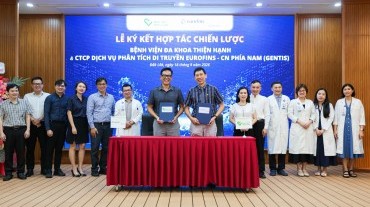
Representing Eurofins GENTIS were Mr. Nguyen Quang Vinh – General Director; Mr. Hoang Dinh Khiem – Business Director; Mr. Bui Quoc Kha – Deputy Director of the Southern Branch; MSc. Nguyen Van Huynh – Research & Development (R&D) Center; and Ms. Nguyen Vu Phuong Linh – Business Manager of the Southern Branch.
Representing An Sinh General Hospital were Dr. Nguyen Anh Danh – Head of the Assisted Reproductive Technology Unit; Specialist Level I Physician Huynh Thi Trong – Consulting Physician, Former Head of the Department of Obstetrics and Gynecology; MSc., MD Vuong Dinh Hoang Dung and Specialist Level I Physician Le Tan Vinh – Assisted Reproductive Technology Unit; Dr. Truong Thi Kieu Trinh; and Dr. Nguyen Duy Hoang Minh Tam.
PGT Provides Additional Genetic Information Before Embryo Transfer
PGT refers to a group of genetic tests performed on cells obtained through embryo biopsy during in vitro fertilization (IVF), aiming to assess certain genetic characteristics of embryos before embryo transfer. Depending on the testing objectives, PGT may focus on chromosomal numerical abnormalities, structural chromosomal abnormalities, or monogenic disorders for which a familial risk has been identified.
In assisted reproductive practice, the selection of an appropriate PGT test should be considered based on obstetric history, the genetic characteristics of both partners, relevant test results, and consultation with specialists. PGT does not replace prenatal diagnosis and cannot assess all possible genetic abnormalities that may occur in a fetus.
At Eurofins GENTIS, the PGT testing system has been developed with multiple solutions to address different genetic assessment needs. PGT-NEXT, PGT-M, PGT-MAX 1, and PGT-UPGRADE were among the solutions introduced and discussed during the program.

PGT-NEXT Provides Additional Information on Embryo Ploidy Status
In addition to PGT-A/PGT-SR, assessing embryo ploidy status may provide additional information in certain specific cases. PGT-NEXT has been developed to support the detection of polyploid embryos and the identification of embryos with a normal diploid chromosome complement.
A notable feature of PGT-NEXT is its expanded assessment of embryos with abnormal fertilization patterns, such as 0PN, 1PN, or 2.1/3PN. Through chromosome analysis, the test can identify embryos with a normal diploid chromosome complement within these groups, thereby providing additional genetic information for physicians and embryologists to consider when assessing and selecting embryos before embryo transfer.
PGT-NEXT is performed using samples obtained from day-5 embryo biopsies, with an expected turnaround time of 3–4 weeks.

PGT-M for Screening Monogenic Disorders Before Embryo Transfer
At Eurofins GENTIS, PGT-M can be performed for more than 100 genes/monogenic disorders, depending on the characteristics of the variant and the feasibility of designing the test for each individual case. The testing process combines direct identification of disease-causing variants with genetic linkage analysis, providing additional information to support the assessment of the embryo's genotype.
One aspect emphasized in the implementation of PGT-M at GENTIS is the use of bioinformatics tools to select and analyze appropriate genetic markers based on the characteristics of the Vietnamese population.
The PGT-M process at GENTIS is performed in accordance with practice recommendations from the European Society of Human Reproduction and Embryology (ESHRE). Eurofins GENTIS's laboratory is CAP-accredited for PGT and NIPT services, providing an important foundation within the laboratory quality control system.
The turnaround time for PGT-M depends on the specific disorder and the family's genetic characteristics. For Thalassemia involving the HBB, HBA1, and HBA2 genes, the expected turnaround time is 12 days. For other monogenic disorders, the turnaround time may range from 20 to 60 days.
PGT-MAX 1 Expands the Detection of Certain Structural Chromosomal Abnormalities
In addition to aneuploidy assessment, certain structural chromosomal abnormalities may be associated with genetic syndromes and affect embryo development. PGT-MAX 1 is a high-resolution PGT-A/PGT-SR solution developed to expand the detection of certain structural chromosomal abnormalities and several common microdeletions.
The test can assess aneuploidy across all 24 chromosomes while detecting structural abnormalities, including gains or losses larger than 5 Mb. In addition, PGT-MAX 1 can detect several common microdeletions larger than 2 Mb, including 22q11.2 deletion, which is associated with DiGeorge syndrome, and 1p36 deletion, which is associated with 1p36 deletion syndrome.
PGT-MAX 1 is performed using samples obtained from day-5 embryo biopsies, with an expected turnaround time of 7–10 days.
PGT-UPGRADE Provides Additional Information for Embryos with Balanced Translocations
In couples where one partner carries a balanced chromosomal translocation, the formation of gametes may result in different chromosomal combinations. Some embryos may inherit an unbalanced chromosome complement, which may be associated with implantation failure, miscarriage, or chromosomal abnormalities.
PGT-UPGRADE has been developed to provide additional genetic information in these cases. In addition to assessing aneuploidy across all 24 chromosomes and certain structural abnormalities larger than 5 Mb, the test can identify embryos carrying a balanced translocation corresponding to the translocation previously identified in the father or mother.
For testing, parental samples consist of 2–3 mL of whole blood, together with a karyotype result confirming the balanced translocation. Embryo samples are obtained through biopsy of day-5 embryos, with a minimum requirement of four embryos according to the testing procedure. The expected turnaround time is 14 days.

Strengthening Professional Collaboration in Reproductive Genetics
Through this scientific exchange with An Sinh General Hospital, Eurofins GENTIS had the opportunity to provide more in-depth information on PGT testing solutions and discuss practical cases with physicians in the process of assisted reproductive counseling and treatment.
As reproductive medicine increasingly places greater emphasis on genetic factors, collaboration among clinicians, embryologists, and genetic laboratories plays an important role in selecting appropriate testing methods, preparing samples, analyzing results, and interpreting findings. Eurofins GENTIS and An Sinh General Hospital look forward to maintaining and expanding professional exchanges, strengthening connections between assisted reproductive units and genetic laboratories, and keeping healthcare professionals updated on advances in embryo genetics to support physicians in counseling and patient care.
Through these professional exchanges, both organizations aim to strengthen collaboration between clinical practice and laboratory testing while promoting the sharing of knowledge and experience in applying genetic testing to assisted reproductive practice.









Để lại bình luận
0 Bình luận